TOOLS & TECHNOLOGY
Tools used with judgment
heavy-vehicle scan and programming tools, air-brake and pressure test equipment, multimeters and network diagnostics, heavy lifts, jacks and stands, engine, alignment and emissions equipment.
 Educator hub
01 · WHAT · TRANSPORT PATH
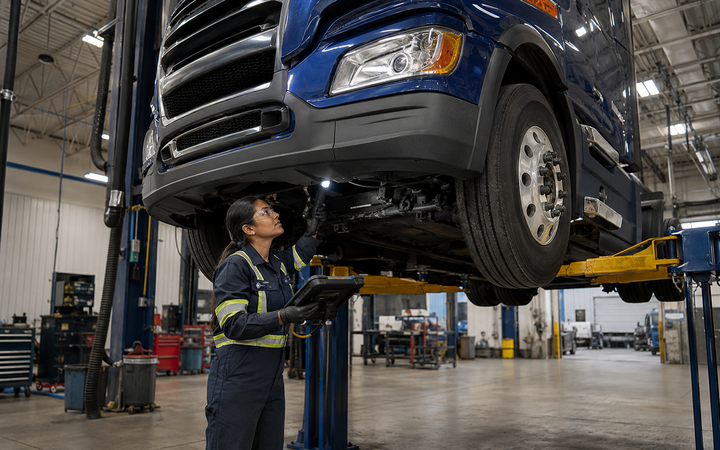
A Truck and Coach Technician inspects, repairs and maintains commercial trucks, emergency vehicles, buses and road transport vehicles by performing work on structural, mechanical, electrical and electronic systems. Specifically, a Truck and Coach Technician inspects, repairs and maintains:
THE CORE OF THE WORK
A Truck and Coach Technician inspects, repairs and maintains commercial trucks, emergency vehicles, buses and road transport vehicles by performing work on structural, mechanical, electrical and electronic systems. Specifically, a Truck and Coach Technician inspects, repairs and maintains:
Not every Truck and Coach Technician performs every task. The mix changes with the employer, sector, workplace, equipment and level of responsibility.
TOOLS & TECHNOLOGY
heavy-vehicle scan and programming tools, air-brake and pressure test equipment, multimeters and network diagnostics, heavy lifts, jacks and stands, engine, alignment and emissions equipment.
WORKING CONDITIONS
large vehicles and heavy components; air, hydraulic and electrical stored energy; shift, roadside and emergency work; diesel exhaust, noise and fluids; compulsory-trade accountability.
SAFETY FIRST
Training, supervision, safe procedures, appropriate PPE and stopping when conditions are uncertain are essential. Requirements vary by workplace and assignment.
STRENGTHS THAT GROW
ADVANCED SPECIALIZATIONS
These are advanced work directions within or adjacent to Truck and Coach Technician, not promises of separate credentials or pay. Requirements vary by employer, equipment, experience and any additional training or authorization.
Diagnose combustion, fuel, air, aftertreatment and cooling systems.
Inspect and repair compressors, valves, chambers, controls and foundation brakes.
Trace starting, charging, lighting, multiplex and network faults.
Service clutches, automated manuals, axles, shafts and differentials.
Restore handling, ride height, geometry and component condition.
Maintain passenger doors, accessibility, climate and body systems.
Work on high-voltage propulsion, energy storage and thermal systems when qualified.
Support fire, refuse, utility and other duty-specific equipment.
Diagnose breakdowns and complete controlled repairs away from the shop.
Advance into inspection, planning, training, supervision or management.
EVIDENCE BASE
Regulated, numerical and time-sensitive claims link to the authority used. Accessed and reviewed August 25, 2026.
Why might this career fit me?