Relay and Instrumentation Technician overview

01 · WHAT · ASSEMBLE PATH

What is the Relay and Instrumentation Technician trade?

A Relay and Instrumentation Technician performs some or all of the following:

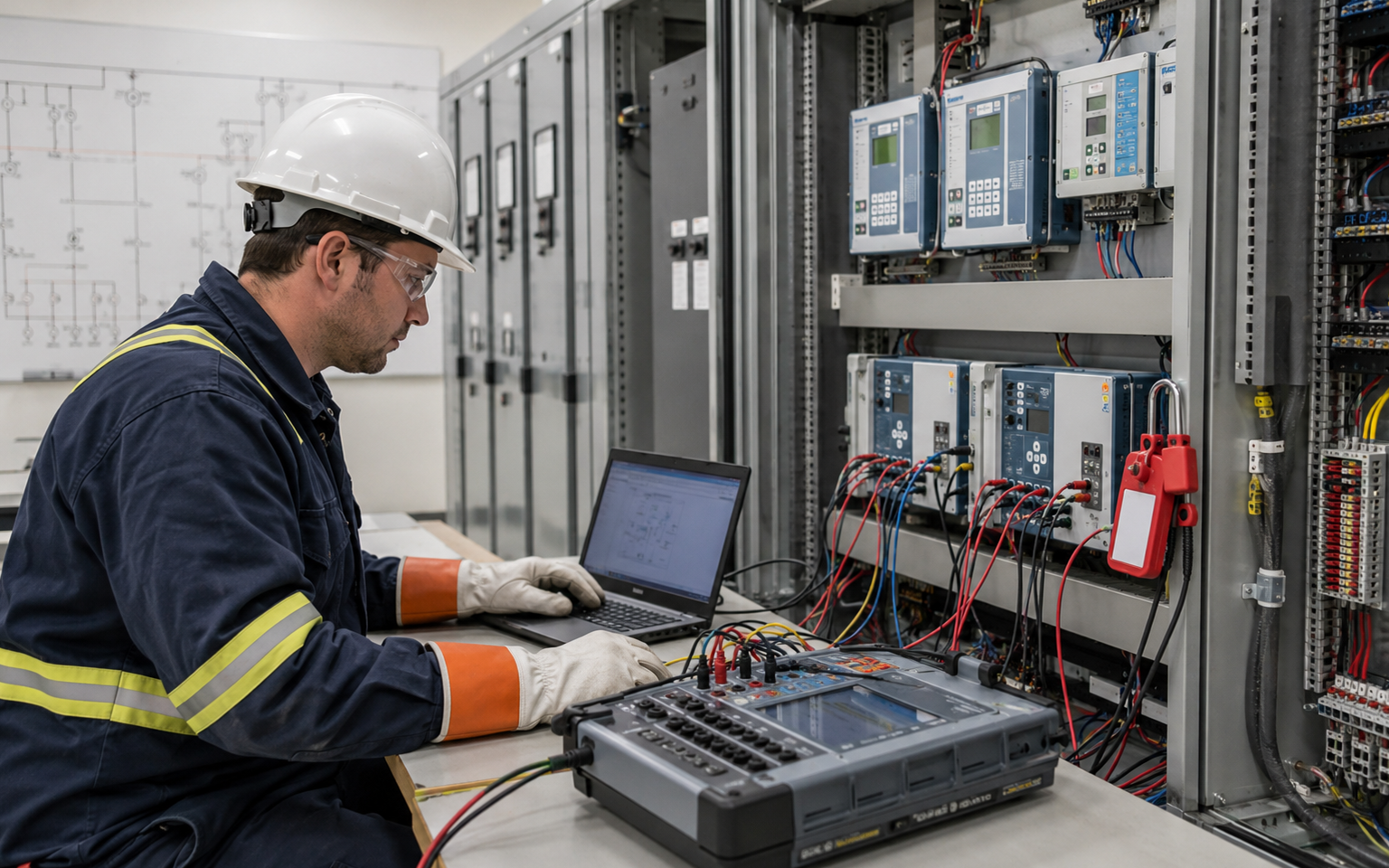
Relay and Instrumentation Technician in a representative work setting

THE CORE OF THE WORK

Inspect. Diagnose. Repair. Improve.

A Relay and Instrumentation Technician performs some or all of the following:

Not every Relay and Instrumentation Technician performs every task. The mix changes with the employer, sector, workplace, equipment and level of responsibility.

TOOLS & TECHNOLOGY

Tools used with judgment

protective-relay test sets, secondary-injection and calibration equipment, digital multimeters and oscilloscopes, SCADA, data-acquisition and diagnostic software, schematics, event records and communications analyzers.

WORKING CONDITIONS

Understand the environment

high-voltage environments and arc-flash boundaries; critical protection and control systems; planned outages and emergency callouts; precise testing and documentation; legacy equipment beside digital networks.

SAFETY FIRST

Learn the hazards before the task

Training, supervision, safe procedures, appropriate PPE and stopping when conditions are uncertain are essential. Requirements vary by workplace and assignment.

STRENGTHS THAT GROW

Skill develops through practice.

electrical theorylogical troubleshootingcalibration precisiondata interpretationprocedural discipline

ADVANCED SPECIALIZATIONS

One trade can lead to very different work.

These are advanced work directions within or adjacent to Relay and Instrumentation Technician, not promises of separate credentials or pay. Requirements vary by employer, equipment, experience and any additional training or authorization.

Protective relays

Test overcurrent, differential, distance and other protection functions.

Substation control systems

Maintain trip circuits, interlocks, annunciation and station controls.

SCADA and data acquisition

Diagnose remote terminal units, telemetry, time synchronization and communications.

Metering and instrumentation

Calibrate electrical measurements, transducers and recording systems.

Commissioning

Verify wiring, settings, logic and end-to-end operation before energization.

Fault analysis

Interpret event records and system behaviour after disturbances.

Protection leadership

Advance into testing coordination, engineering support or supervision.

EVIDENCE BASE

Sources & verification

Regulated, numerical and time-sensitive claims link to the authority used. Accessed and reviewed August 25, 2026.

CONTINUE THE CAREER CENTREWHY

Why might this career fit me?