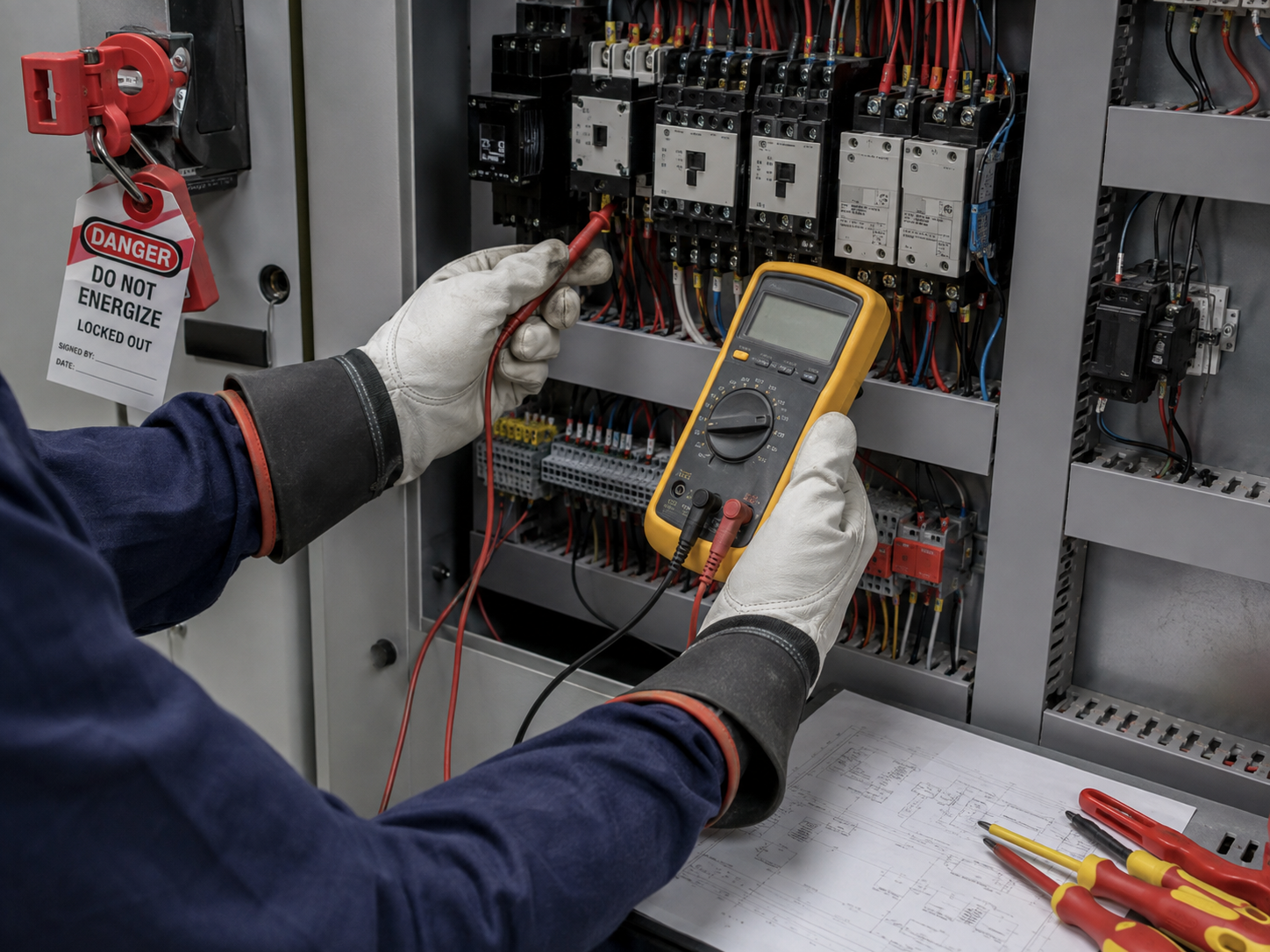
These are advanced work directions within or adjacent to the Industrial Electrician trade, not separate Ontario trade classifications. Requirements vary by employer, industry, equipment and worksite; some pathways require additional technical training, manufacturer credentials or regulatory authorization.
Automation and PLC systems
Program, commission and troubleshoot programmable controllers, industrial networks, sensors and automated production sequences.
Instrumentation and process control
Work with transmitters, control loops, process measurements and control equipment in manufacturing, utilities and continuous-process plants.
Industrial power and high voltage
Develop deeper experience with transformers, switchgear, protection, distribution and large industrial power systems, with added training and authorization where required.
Motors, drives and motion control
Specialize in motor control centres, variable-frequency drives, starters, servos and the systems that keep industrial machinery moving accurately.
Robotics and advanced manufacturing
Install, integrate and troubleshoot robot cells, safety circuits, machine interfaces and automated material-handling equipment.
Reliability and predictive maintenance
Use condition monitoring, thermal imaging, testing, maintenance data and root-cause analysis to prevent failures and improve uptime.
Energy systems and power quality
Support renewable-energy equipment, energy management, power-quality improvement, storage systems and facility-efficiency projects.
Planning and leadership
Progress toward lead hand, maintenance planner, supervisor, project coordinator, reliability specialist or maintenance manager roles.
Independent work
Experienced workers may pursue contracting or consulting, subject to business, safety, insurance and any licensing requirements for the services offered.