TOOLS & TECHNOLOGY
Tools used with judgment
telescopic and lattice-boom cranes, load charts and lift-planning software, wire rope, blocks and rigging, outriggers, mats and counterweights, radios and safety devices.
 Educator hub
01 · WHAT · TRANSPORT PATH
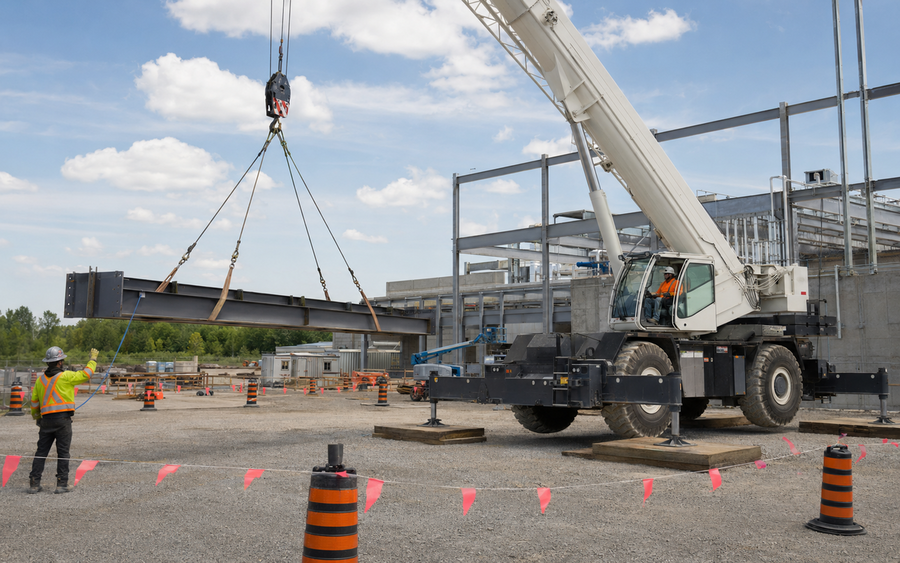
A Hoisting Engineer — Mobile Crane Operator 1 maintains and operates conventional lattice and telescopic boom mobile cranes that can lift, move, position and place materials and equipment weighing more than 16,000 pounds, such as concrete, steel, gravel and other construction supplies and machinery at construction and industrial sites, ports, factories, warehouses, dockyards or rail yards. Specifically, a Hoisting Engineer — Mobile Crane Operator 1:
THE CORE OF THE WORK
A Hoisting Engineer — Mobile Crane Operator 1 maintains and operates conventional lattice and telescopic boom mobile cranes that can lift, move, position and place materials and equipment weighing more than 16,000 pounds, such as concrete, steel, gravel and other construction supplies and machinery at construction and industrial sites, ports, factories, warehouses, dockyards or rail yards. Specifically, a Hoisting Engineer — Mobile Crane Operator 1:
Not every Hoisting Engineer — Mobile Crane Operator 1 performs every task. The mix changes with the employer, sector, workplace, equipment and level of responsibility.
TOOLS & TECHNOLOGY
telescopic and lattice-boom cranes, load charts and lift-planning software, wire rope, blocks and rigging, outriggers, mats and counterweights, radios and safety devices.
WORKING CONDITIONS
critical suspended loads; changing ground and weather; travel and irregular hours; assembly and transport logistics; compulsory-trade accountability.
SAFETY FIRST
Training, supervision, safe procedures, appropriate PPE and stopping when conditions are uncertain are essential. Requirements vary by workplace and assignment.
STRENGTHS THAT GROW
ADVANCED SPECIALIZATIONS
These are advanced work directions within or adjacent to Hoisting Engineer — Mobile Crane Operator 1, not promises of separate credentials or pay. Requirements vary by employer, equipment, experience and any additional training or authorization.
Operate hydraulic multi-section booms across varied lifts.
Configure conventional cranes for reach and capacity.
Place vessels, machinery and structural assemblies.
Support bridges, transit and major civil projects.
Lift tower, nacelle and blade components under strict limits.
Coordinate multi-point and engineered lifting arrangements.
Plan counterweights, boom sections and road moves.
Advance into lift planning, supervision or crane management.
EVIDENCE BASE
Regulated, numerical and time-sensitive claims link to the authority used. Accessed and reviewed August 25, 2026.
Why might this career fit me?